Summer School 2026 Is a Wrap: How It Went, and Why It Worked
Yunwen Eric
··
8 min read
Weeks of robotics, programming, AI, web development and design with young innovators aged 7 to 18 — and three websites, hand-typed and shipped live, to show for it. Here is what happened at Togeva STEAM Summer School 2026, and why we would run it the same way again.
There is a version of a school holiday where nothing much happens. Six or seven weeks pass, the routine dissolves, and by September a child has to be rebuilt from scratch — the reading habit, the attention span, the confidence. We built Togeva STEAM Summer School as an answer to that version. Not extra school. Not homework in disguise. A workshop, with real tools, where the thing you make at the end is yours and it works.
The 2026 edition has now ended. Registration is closed, the certificates are handed out, and the gallery is up. This is the honest account of it.
The premise was simple: introduce children and teenagers to the technologies actually shaping the world around them — artificial intelligence, robotics, code, the web, design — through building rather than through slides.
STEAM is Science, Technology, Engineering, Arts and Mathematics, and the "A" is not decoration. A student who can write a loop but cannot make a page that someone else wants to look at has half a skill. A student who can design a beautiful interface but has never made a button actually do anything has the other half. We wanted both halves in the same room, in the same week, in the same child.
Around that sat three things we held to: every student leaves with something they built, not just something they attended; no child is held back or left behind by the age of the child next to them; and mentorship is a relationship, not a lecture.
Summer School 2026 Is a Wrap: How It Went, and Why It Worked
We split the cohort into three age tracks, because seven and seventeen are not the same person and pretending otherwise fails both of them.
Junior Explorers (7–10) worked in Scratch — block-based programming, basic robotics, STEM games, creative digital projects. The goal at this age is not syntax. It is the discovery that a computer will do exactly what you tell it to, including the wrong thing, and that this is funny rather than frightening.
Young Innovators (11–14) moved into web development basics, real programming, robotics systems, AI tools and the foundations of UI design. This is the age where abstraction starts to land — where a student stops copying a sequence and starts asking what would happen if.
Future Builders (15–18) went further: applications, AI concepts, real-world web projects, product design, and team innovation challenges. For this group the question shifted from "can I make this work?" to "would anyone use this?"
The week had a rhythm we kept deliberately steady. Tuesdays were web development and UI design. Wednesdays were robotics and engineering — building, wiring, sensors, motors, the satisfying business of making a physical object obey you. Fridays were the innovation lab and team projects, when students worked on their own builds and helped each other debug.
Around that core ran the parts that are easy to cut and shouldn't be: innovation challenges, STEM competitions, one-on-one mentorship sessions, tech talks and career guidance, and Demo Day at the end.
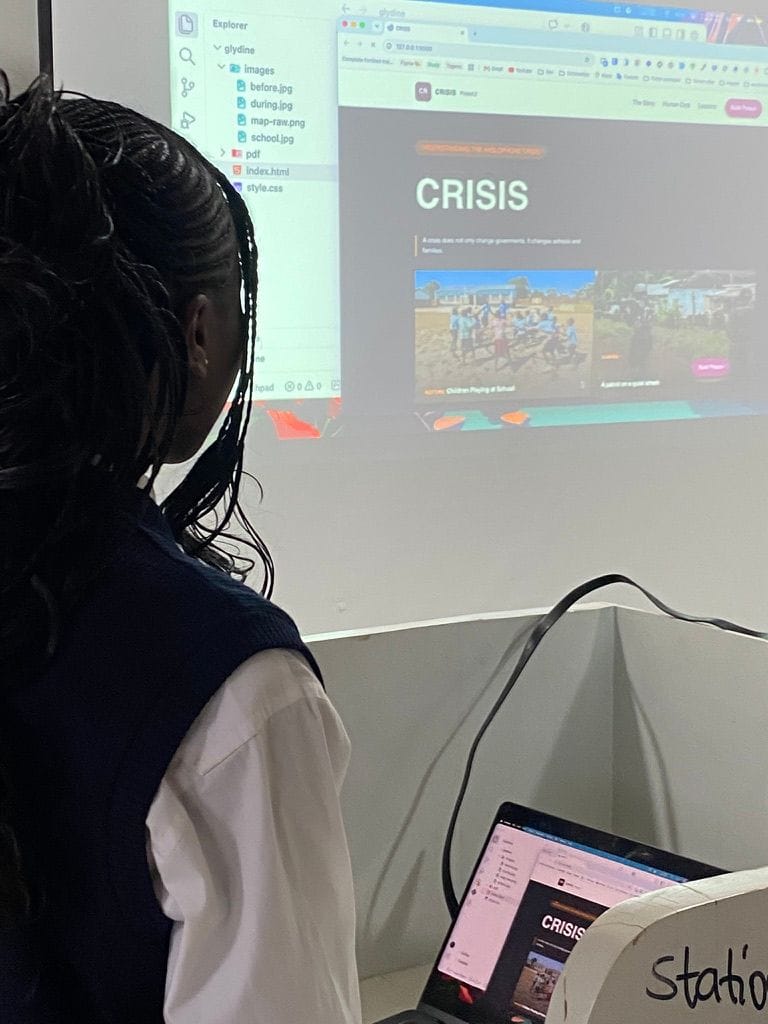
The clearest evidence of what happened this summer is the work from the web development track. Three complete websites, typed by hand in HTML and CSS, laid out entirely with flexbox. No frameworks. No build step. No template downloaded and renamed. All three are live on the internet right now, and all three have their source code open for anyone to read.
Portfolio — a personal portfolio in eight blocks: hero, about, skills, projects, interests, contact. It is the first project where the student is the subject, and that changes how much care goes into it. (Live site · Source )
CRISIS — a long-form explainer on the Anglophone Crisis: its history, its human cost, and two possible futures. Every factual claim on the page carries its source. Teaching a teenager to cite is teaching them to think. (Live site · Source )
Understanding AI — fourteen sections, each answering one question about artificial intelligence: how it learns, how to prompt it well, and how to use it to learn rather than to copy. Zero lines of JavaScript. (Live site · Source )
That last project deserves a note. We did not ban AI tools from the room. We taught students to interrogate them — to understand what a model is doing when it answers, to write a better prompt, and to tell the difference between using a tool to understand something and using it to avoid understanding something. Then we asked them to explain all of it, in their own words, on a page they built themselves. It is difficult to fake having learned something you have had to teach.
The projects were real, and public. A worksheet gets marked and thrown away. A live URL gets sent to your aunt. When a student knows the output has an audience, the standard they hold themselves to changes without anyone raising it.
We taught the fundamentals, not the shortcuts. Hand-typed HTML and CSS, flexbox, no framework. It is slower. It is also the difference between a student who can build a page and a student who can only assemble one. The same principle held in robotics: wire it, watch it fail, find out why.
Mixed ages, separate tracks, shared room. Older students explained things to younger ones, which is the fastest way to discover whether you actually understand something. Younger students saw what was possible three years ahead of them, which is worth more than any motivational talk.
Mentorship was continuous. Not a visiting speaker at the end, but people in the room every week who had done the work and could sit next to a student and debug with them.
The years between seven and eighteen are where a young person quietly decides what kind of person they are. Not through a career choice — through a hundred small verdicts. I am good at this. I am not a maths person. That is for other people. Those verdicts are formed early, they are formed from very little evidence, and once formed they are difficult to reverse.
A summer programme intervenes at exactly the right point, for a few reasons.
Time. The school year is structured around coverage and assessment. There is rarely room to spend three weeks on one project, get it wrong, and start again. Holidays have that room. Depth is a luxury the timetable cannot afford and the holiday can.
Failure without stakes. No grade attached. A robot that drives into a wall is data, not a mark on a report. Students take risks they would never take in a graded environment, and risk-taking is where the learning density is highest.
Early exposure, wide options. A child cannot aspire to a career they have never seen. Software engineering, AI, robotics, product design — these are abstractions until a student has spent a Wednesday afternoon wiring a sensor to a motor and watching it respond. After that, they are options.
Confidence, which transfers. A student who has shipped a live website carries that into a physics classroom in September. The subject changes; the belief that a hard thing can be understood does not.
Closing the gap early. In Cameroon and across the continent, access to technology skills is still unevenly distributed — and the gap widens with every year it is left alone. Reaching students at seven, eleven and fifteen rather than at twenty-two is not simply earlier. It is a different outcome.
There is one more reason that is easy to overlook: a workshop is where friendships form around building things. Students who debug together stop seeing technology as a solitary pursuit, which is often the quiet reason people drop out of it later.
For students: real digital and STEAM skills, creativity and confidence, portfolio projects that exist outside a classroom, mentorship from working innovators, and access to the Togeva community.
For parents: a structured holiday, a productive use of a long summer, early exposure to technology careers, and a safe, guided environment where curiosity is the point.
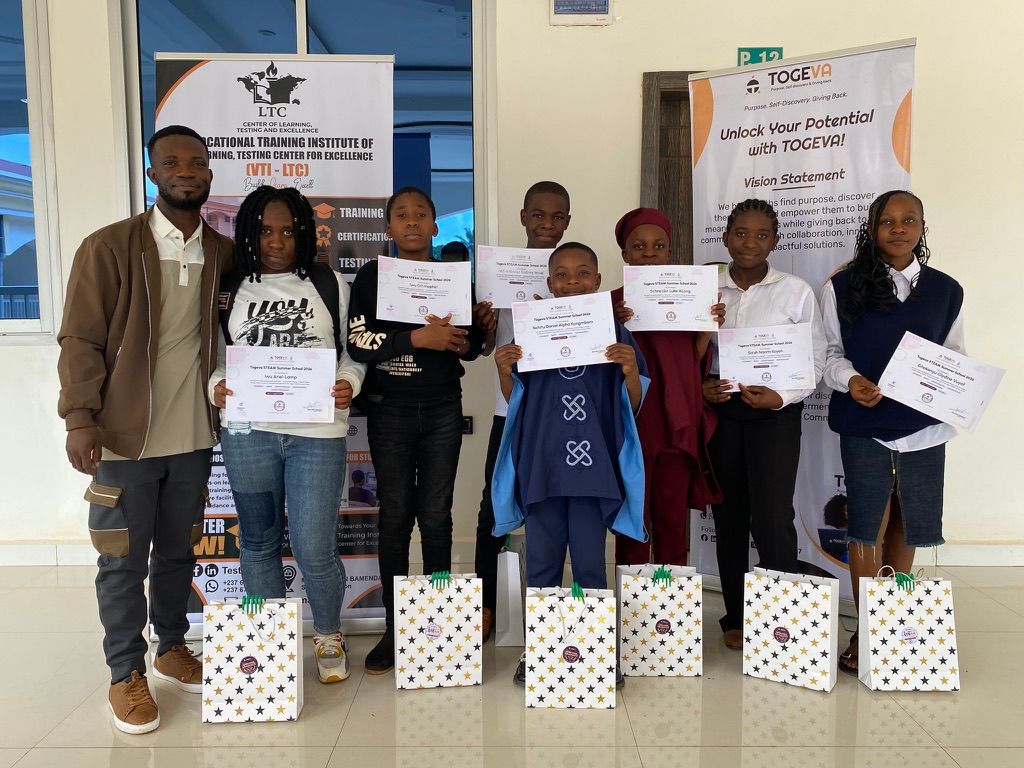
Every participant left with a certificate of participation, portfolio projects, a Demo Day presentation behind them, and a place in the Togeva learning community.
Summer School 2026 is closed, but Togeva runs year-round — orientation seasons, mentorship, and the programmes that sit alongside them.
Browse the 2026 gallery to see what our young innovators built. And if you would like to hear first when the next edition opens, message us — we will let you know before registration goes public.
To the students who showed up at the start of the holiday with no idea what a flexbox was and left with a live website: thank you. You made the case for this programme better than we ever could.